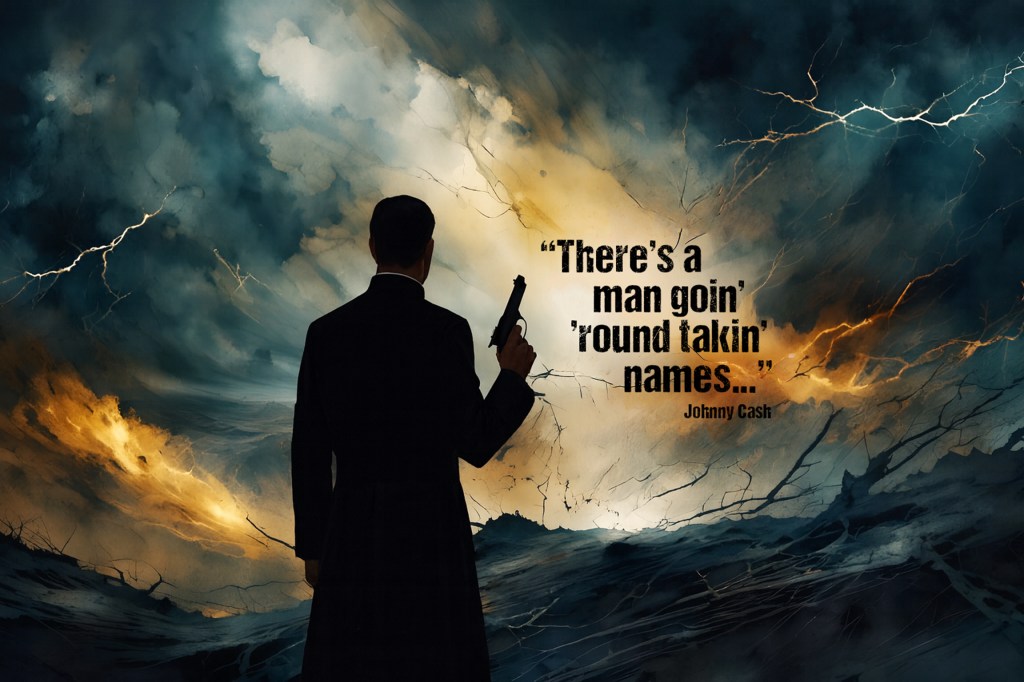
Why is this study necessary?
In strictly practical terms, perhaps it isn’t necessary. However, experience has already taught me that the particularly earnest pietists among us are likely foaming with angst, insisting that a novel like this, written by a pastor, ought not to be.
Rest assured, I’m not a reed shaken by the wind. And I have very thick skin. Say what you will.
Nevertheless, this study, therefore, exists partly as an attempt to do the dangerous thing of thinking out loud, asking questions, and following ideas where they lead, even as the guardians of Proper Seriousness arrive to assure me that imagination resulting in fictionalized action, humor, curiosity, violence, or whatever are all best kept on a very short leash. In other words, if we are going to have opinions about such things—and rest assured that people do—we might as well have them after a bit of reflection rather than out of sheer reflex.
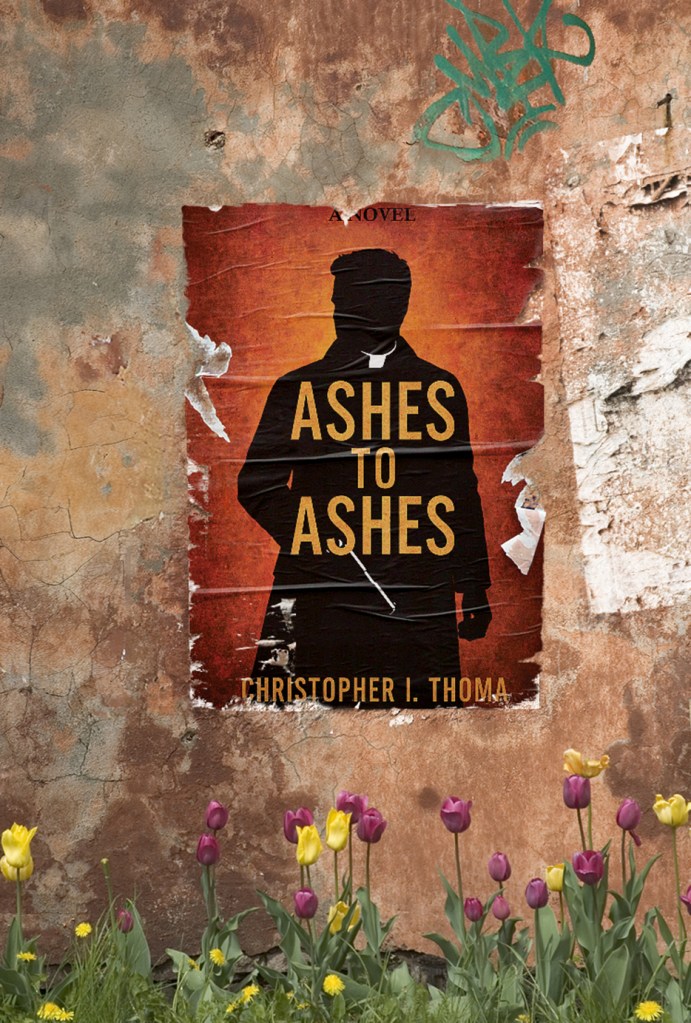
Beyond these things, what follows is essentially an examination and extrapolation of questions that emerged during my conversation with the prospective screenwriter, who was exploring the possibility of adapting Ashes to Ashes for film. Not all of the questions below were asked directly during our discussions. In several cases, the questions that follow represent ideas that surfaced afterward as I continued thinking through what was said.
Furthermore, I told my conversation partner that the entire process is new to me. Not to mention, and as I shared with him at the beginning of our first conversation, I was a little intimidated by the experience. When that conversation concluded, I realized I’d left some important things unsaid. This is to say, I could have given fuller answers or clarified certain ideas more carefully. What follows, then, are the deeper, more thorough reflections that came to mind after the conversation ended. I believe they’ll be of service to both fan and pietist alike.
—Rev. Dr. Thoma+
I. Core Character Questions
1. Who is Daniel Michaels?
Daniel is a confessional Lutheran pastor who is morally serious, disciplined, and acutely shaped by his vocation. He sees himself as a man who “stands in the stead and by the command of Christ,” ultimately being a shepherd responsible for protecting his flock. His identity is deeply rooted in pastoral duty, moral order, and theological and liturgical conviction.
Note, also, his name. It was the Prophet Daniel who, for his faithfulness, was cast into the lions’ den, and yet was delivered (Daniel 6). And it was Michael, the archangel, who was pitted against the dragon and his legions in the great war in heaven, ultimately casting them out (Revelation 12:7–8). That victory did not come by quiet decree, as though, in the critical moment, heaven itself were exempt from struggle when opposition was required. It’s described as conflict—a war waged and won through direct intervention.
2. What causes the change in Daniel?
The murder of Claire Madsen and the discovery of her investigative files expose a hidden trafficking network operating within his community. Claire had intended to seek Daniel’s help, which produced profound guilt when he realized he had delayed responding to her plea.
3. What’s Daniel’s central psychological issue? Or perhaps better asked, what is his deepest wound?
Moral injury combined with guilt. Claire trusted him to act, but he postponed visiting her. Her death makes him feel personally responsible for failing to protect her.
This type of guilt is not unusual in pastoral life. Pastors are constantly confronted with suffering they cannot fully repair—broken marriages, illness, addiction, grief, poverty, spiritual despair. A pastor’s instinct is to help, to fix, to guide people toward healing. Yet the reality of ministry is that no pastor can ever do enough. The needs of a congregation are endless, and the pastor’s time, energy, and emotional capacity are limited. For pastors who genuinely love their congregation, this limitation can produce a persistent sense of inadequacy. Even when they do much good, they remember the moments when someone needed them, and they could not be present, when exhaustion forced them to delay a visit, or when a problem remained unresolved. Those moments linger. Over time, they can accumulate into a quiet but powerful guilt—the feeling that if one had only acted sooner, stayed longer, listened more carefully, or pushed harder, perhaps things might have turned out differently. Maybe the marriage wouldn’t have crumbled. Maybe this. Maybe that. Maybe, maybe, maybe.
Daniel’s guilt over Claire operates within this familiar pastoral tension but in an amplified way, considering the crime. What pastors often experience as a nagging question—Did I do enough?—becomes, for him, a crushing conviction that he failed in the worst way and at the very moment when he might have made the difference. I suppose that, even as the author, who is also a pastor, I can’t even begin to describe how significant this is in the lives of clergy who only want to be faithful to God and the people in their care.
4. What identity conflict does Daniel experience?
He’s struggling between two identities. He’s a pastor committed to faithfulness, which translates into a desire to preach and teach the Gospel rightly, and to administer the Sacraments according to Christ’s command. But as a shepherd, he’s also a protector, and he’s compelled to stop evil immediately. Indeed, his pastoral identity remains intact even as his actions increasingly contradict it.
II. The Questions of Motivation
1. Why does Daniel believe killing might be necessary?
Because he concludes that traditional institutions—law enforcement, civic leadership, and even other churches—are compromised or ineffective in confronting the crimes Claire uncovered, and ultimately cost her life.
2. What’s the moral paradox in his actions?
Daniel simultaneously believes that killing is morally wrong, but that allowing evil to continue, especially when you know something about it and can act to stop it, this is far worse. He resolves the tension by accepting that he may sacrifice his own moral standing, even his own life, to stop evil and be like his Savior. Imitate me as I imitate Christ, Saint Paul would say. Daniel is being a savior of sorts.
3. Does Daniel see himself as a murderer?
Not entirely. Dietrich Bonhoeffer comes to mind. Within this sphere exists the knowledge that if he gets caught, he will accept the consequences. Nevertheless, come what may, he sees himself as a defender of the innocent and an instrument of justice, acting where institutions have failed and where others, in general, refuse to act (Luke 10:25-37). This leads to another question worth considering, especially since Bonhoeffer acted as he did, even in his clerical collar.
4. Why does Daniel wear his clerical collar?
It reinforces that he is acting as the same person he has always been—a pastor—rather than abandoning his identity. It turns the act into something resembling a grim form of pastoral duty, letting the ones to whom he brings justice sense the divine nature of what’s about to happen. Thus, “I’m here for your confession,” and “Kyrie eleison” (Lord have mercy), a mixed-up rendition of Law and Gospel, confession and absolution.
III. The Story’s Turning Points
1. When does Daniel first seriously contemplate violence?
When he starts digging into Claire’s documentation and discovers the trafficking network, which hits incredibly close to home, including men he knows personally—respected members of his own church. When he hears the recordings, reads the journals, and so on, the combination of guilt overwhelms him.
2. Why does this even matter?
First, a pastor is responsible for the people in his care, whether “good” or “bad.” He deals Law and Gospel to both. I’ve had members end up in jail. Even there, I serve and care for them. Second, the perpetrators are not anonymous criminals. They are familiar community figures and church members whose betrayal violates Daniel’s trust and moral expectations in the grossest ways.
3. What moment, perhaps, marks the complete collapse of his restraint?
After considering exposing the evidence through legal channels, Daniel realizes that the part of him willing to rely on the system is torn and uncertain. The possibility that the perpetrators could escape justice convinces him that the system can’t be trusted.
4. What external influence accelerates this decision?
A conversation with Chief Stern in Chapter 30, who remarks that if his own daughter were harmed, he would personally hunt down and kill the one’s responsible. Love is the fulfillment of the Law, as Saint Paul says. Though intended as a hypothetical statement, Daniel hears it as a tacit justification that aligns with the scriptural teachings on vocation in relation to evil. The Magdeburg Confession is a document worth reading in this regard. Also, consider practically that a father, according to his vocation, must be judged as loveless if he does not seek justice for his raped daughter. There will always be time for the forgiveness of sins. Until then, order must be restored. How that order comes about is often undetermined. But either way, as in the case of the Good Samaritan (Luke 10)—he does not pass by to accomplish his Levitical or priestly duties in service to the Gospel, but instead, he stops, sets things in order for the dying man. He acts in the moment to help the innocent.
IV. Psychological Mechanisms
1. Why does Daniel become calmer, almost robotic at moments, as he moves deeper into the violence?
Early on, it’s shock and uncertainty. But once he resolves the moral dilemma, the uncertainty begins to dissipate. His earlier anxiety and nausea are replaced more so by determination, all the while accepting the possibility he’ll likely receive what his crimes are owed.
2. What childhood experiences foreshadow his later actions?
Plenty are shared in the narrative. For example, as a child, Daniel learned that when his younger sister was distressed, no adult—no one who could actually help—would intervene. He internalized the belief that if he did not act, no one would. See also the account of his baseball glove in Chapter 11.
3. How do these childhood lessons affect him as an adult?
They form a core instinct. When confronted with suffering or injustice, Daniel assumes personal responsibility rather than waiting for others to solve the problem. If he wants his glove back, he’ll need to confront the bully, even if it means suffering. He will bleed. But he will not quit until things are set right.
V. Theological Questions
1. What’s some of the theology behind Daniel’s internal conflict?
The conflict involves divine justice and human restraint, as well as the certainty that sin will ultimately be judged. There is also the reality Luther described as Anfechtungen. In Lutheran theology, Anfechtungen refers to the deep spiritual assaults, doubts, temptations, and inner anguish that drive believers to wrestle with God and cling more desperately to His promises. These experiences often involve profound moral and existential struggle, in which faith and despair collide within the conscience.
Part of this struggle also involves the question of divine judgment. Scripture makes clear that God does judge sin, even in this life. Sin is punished. Yet the believer is not taught to interpret suffering in a simplistic or superstitious way. A Christian does not receive a diagnosis of cancer or endure some tragedy and conclude, “I must have sinned, and God is punishing me.” The world remains fallen, and bad things happen in a bad world. Even so, a Christian can rest assured that faith in Christ receives the merits of His atoning work. The believer’s sins have been borne by Christ, and therefore, suffering is not interpreted as God’s personal punishment for those sins.
That said, God’s Word does not eliminate the reality that God may sometimes employ events within this fallen world as instruments of judgment. In other words, an unbeliever may experience tragedy, and that tragedy may indeed be God’s active punishment. However—and this is essential—it is not given to the Christian to determine whether any particular tragedy is or is not God’s punishment. Christians do not possess that knowledge. They simply acknowledge that God judges sin and that His judgments occur in ways that are often hidden. Ultimately, the matter belongs to God alone.
Daniel’s turmoil reflects something like this spiritual conflict. On the one hand, he knows the biblical teaching that believers ought not to be avengers. On the other hand, Scripture also portrays God—namely Christ—in His ascended state as the Pantocrator, is the Judge of both the living and the dead. Evil will be punished. How He accomplishes this judgment, again, is often hidden from human view. And yet, the possibility that God may sometimes act through human instruments is part of Daniel’s tension.
2. Why does this matter?
Daniel increasingly views himself as an instrument through which God’s justice may actually be operating in the world.
3. So, then, is that to say Daniel believes God approves of his actions?
Not necessarily. Again, he’s torn. Just like Dietrich Bonhoeffer. He recognizes the moral danger but proceeds anyway, as in a very dark room, believing the victims’ suffering demands intervention. He has in his mind, “Perhaps God…” And so, the reader wonders the same thing, too.
VI. Literary Archetype Questions
1. Dostoyevsky, John Wick, and the assassin in No Country For Old Men, Anton Chigurh, were mentioned in the discussion. What’s the literary archetype Daniel more or less represents?
He’s a torn avenger-priest—a moral authority figure who becomes an unlikely executioner when confronted with injustice.
2. What distinguishes Daniel from typical vigilante characters like John Wick—or, while not a typical vigilante, a character like Anton Chigurh?
There’s a lot to consider here. For starters, Daniel never abandons his moral awareness. He knows his actions may be wrong, but he accepts the burden as the cost of stopping evil. What makes him particularly distinct from more familiar vigilante figures is that he doesn’t become emotionally detached from the moral weight of his actions.
Characters like John Wick operate within a stylized moral universe where violence is expected and governed by its own internal codes. Wick may feel grief or anger, but he rarely pauses to question whether the violent system itself is morally permissible. His world assumes violence as the currency of justice.
After the discussion, since Anton Chigurh was mentioned, I took the liberty of watching No Country for Old Men. Admittedly, I’m no movie critic. However, the Chigurh character represented something even more extreme than Wick. Chigurh is an almost metaphysical force. He acts according to a rigid personal logic that removes moral responsibility from himself entirely. In his mind, the outcome is already determined. He’s merely the instrument through which fate is delivered. The questions he asks along the way imply this clearly. Because of this belief, Chigurh has no moral struggle. His violence is cold, mechanical, and entirely devoid of remorse.
Daniel Michaels is fundamentally different. He doesn’t inhabit a universe where violence is normal, nor does he hide behind fatalism or a personal code that excuses his behavior. Instead, he remains painfully aware that what he’s doing violates the very faith and moral order he represents as a pastor. That tension never disappears. He prays before and after his actions, acknowledging the possibility that he may be condemning himself even as he tries to stop something he believes is far more monstrous.
In other words, Daniel’s defining trait is not brutality or efficiency or excuses, but genuine conscience. Unlike Wick, he doesn’t simply live within a violent system. Unlike Chigurh, he doesn’t believe fate absolves him, because, no matter what Chigurh does, it was meant to be. Daniel carries the full moral burden of his choices and proceeds anyway, believing that failing to act in the face of great evil would be the greater sin burdening his conscience.
3. What emotional state is ultimately driving Daniel?
It’s a combination of things. It’s guilt, moral outrage, protective instinct, and the drive of self-sacrifice. He believes that justice must occur even if it destroys him personally.
VII. Thematic Questions
1. What’s the central theme the story is exploring?
I suppose the best way to answer this is by sharing something I wrote and shared with my congregation when Hollywood first came calling in 2025. It follows:
I’m going to let you in on a little secret, if only because I feel like writing about it. In short, I’ve had a few interesting conversations about my new novel, Ashes To Ashes, with some folks in Hollywood. But that’s not necessarily the interesting part. What stood out in those conversations is that, after reading the book, they all reached back to me with varying versions of the same conclusion. Essentially, they’ve determined that the novel fits the time. In other words, it fits the national zeitgeist, tapping into something raw and unresolved in the public soul.
What they mean is that people are angry.
By angry, they don’t mean the performative kind of anger that burns hot on social media and then disappears by the next news cycle. They mean the deeper kind—the kind that settles into the chest when dreadful things keep happening over and over again at the highest levels, and yet, no one ever seems to get arrested or brought to justice.
I say this as I consider the obvious examples. For starters, the State of Minnesota is riddled with as much as nine billion dollars in fraud, nearly all of it played out among its Somali community. And lest anyone seem racist or anti-immigrant, no one appears to be getting into much trouble for it—at least, not the actual orchestrators. Or consider the Epstein files. There’ve been years of whispers, sealed documents, but also unsealed documents with redactions that hide 99% of the content—all of this leading to dead ends and a gazillion unanswered questions. Everyone knows something happened. Everyone knows there’s a list somewhere. Dark-intentioned people who use other people always maintain the upper hand. They keep lists. They protect audio and video files. We’ve learned that, especially within the last few years, relative to the release of certain CIA files. However, in this case, nothing has happened. There’s likely some really big names on these lists and in these videos. And yet, no one has paid for their crimes. In the end, transparency and accountability remain entirely elusive.
If you’ve read Ashes to Ashes, then you’ll know that frustration with injustice is an element in the topsoil from which it emerges, which is why the folks reading it are responding as they do. The main character, Reverend Daniel Michaels, finds himself in a dreadful situation, ultimately owning some significant evidence. Unsure of whom to trust, when he scans his immediate horizon, he discovers people and organizations that appear immune to consequences. He also learns the cost of inaction paid by ordinary people—young girls being abused and then traded, or simply moved and slaughtered, like cattle. And while ill-willed insiders so easily use the system to their benefit, he steps into the fray and starts taking names. And it gets messy. Very messy.
Now, please understand, that’s not an endorsement of vigilantism. I’m simply making the connection to the original comments while also acknowledging a reality. I had a conversation in my office this past Monday about the book. Essentially, I said that while we might not want to admit it, when justice feels theoretical, people start fantasizing about other ways of leveling the field. When wrongs are endlessly explained away, when excuse after excuse is given for why justice is so slow, anger begins looking for a body to inhabit.
2. What question does the book ultimately ask?
Is it moral to wait for justice—or is it moral to act to stop it? This is layered throughout the narrative.
3. What’s the deeper tragedy of Daniel’s story?
As I already said, he remains fundamentally the same man he was before—a protector of the innocent. The difference is that the circumstances, in his mind, now demand actions that contradict the very faith he represents.
VIII. The Ultimate Character Question to Consider
1. Why does Daniel Michaels, a pastor, kill even though he knows it’s wrong?
Because he becomes convinced that failing to stop the evil would be a greater moral failure than committing violence himself against evil. He’s willing to carry and endure the greater sin in himself to save the innocent.
 Rev. Dr. Christopher I. Thoma